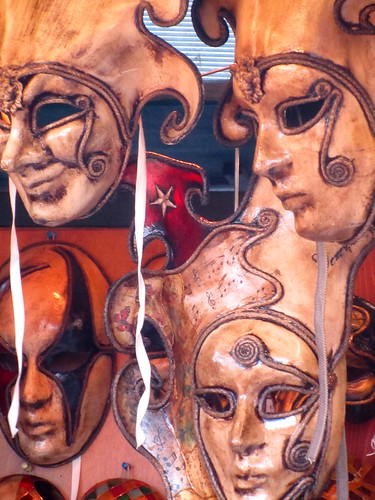
Retropost, 2014:
From The Oxford Companion to English Literature,
ed. Margaret Drabble:
Much Ado about
Nothing, a comedy by *Shakespeare, written probably 1598-9, first printed
1600. Its chief sources are a novella by *Bandello and an episode in Ariosto's
*Orlando Furioso. The play has always
been a popular one in performance.
Ths prince of Arragon, with Claudio and Benedick in his
suite, visits Leonato, duke of Messina, father of Hero and uncle of Beatrice.
The sprightly Beatrice has a teasing relationship with the sworn bachelor
Benedick. Beatrice and Benedick are both tricked into believing the other in
love, and this brings about a genuine sympathy between them. Meanwhile Don
John, the malcontented brother of the prince, thwarts Claudio's marriage by
arranging for him to see Hero apparently wooed by his friend Borachio on her
balcony—it is really her maidservant Margaret in disguise. Hero is publicly
denounced by Claudio on her wedding day, falls into a swoon, and apparently dies.
Benedick proves his love for Beatrice by challenging Claudio to a duel. The
plot by Don John and Borachio is unmasked by the 'shallow fools' Dogberry and
Verges, the local constables. Claudio promises to make Leonato amends. Claudio
promises to make Leonato amends for his daughter's death, and is asked to marry
a cousin of Hero's; the veiled lady turns out to be Hero herself. Benedick asks
to be married at the same time; Beatric, 'upon great persuasion; and partly to
save your life, for I was told you were in a consumption', agrees, and the play
ends with a dance.
From the Oxford Dictionary of Shakespeare, by
Stanley Wells:
Much Ado about
Nothing. Shakespeare's comedy ws first printed in *quarto in 1600, probably
from the author's manuscript. This edition was reprinted in the First *Folio
(1623). The play was not mentioned by *Meres in 1598, and is usually dated
1598-1600. It is based on a traditional story which had been told by Ariosto in
his Orlando Furioso (1516, translated
1591), and by Bandello, translated into French by *Belleforest. It was played
at Court in 1613, and a poem by Leonard *Digges printed in 1640 suggests that
it remained popular. William *Davenant adapted it as The Law Against Lovers (1662), with little success.
The original play was performed in 1721, and there were
further revivals in 1739 and 1746, but it did not fully regain its popularity
until David *Garrick first played Benedick, in 1748, after which he revived it
regularly until he retired in 1776. His first, and greatest, Beatrice was Mrs.
*Pritchard.
During the later part of the century Frances Abington and
Elizabeth Farren shone as Beatrice. Charles *Kemble succeeded as Benedick from
1803, and the play's popularity during the nineteenth century culminated in
Henry Irving's *Lyceum revival of 1882, in which Ellen *Terry gave her
legendary Beatrice, which she went on playing for a quarter of a century.
The most famous twentieth-century production is John
*Gielgud's at Stratford-upon-Avon, first given in 1949, when he did not appear
in it, but revived in 1950 with himself as Benedick and Peggy *Ashcroft as
Beatrice, and repeated several times during the 1950s.
Much Ado about Nothing
has proved to be one of Shakespeare's most resilient plays.
Twentieth-century productions have frequently updated the action. Hugh Hunt
directed it in modern dress in 1947. Douglas Seale, at Stratford-upon-Avon in
1958, in costumes of about 1851, Franco *Zeffirelli, at the *Old Vic in 1965
in a farcical version set in late nineteenth-century Sicily, John *Barton at
Stratford-upon-Avon in 1976 in a setting of nineteenth-century British india
with Judi *Dench an unusually serious, and wholly credible, Beatrice, and Terry
*Hands, also at Stratford-upon-Avon, in 1982. Susan Fleetwood and Roger Allam
played Beatrice and Benedick in Bill *Alexander's production (Stratford, 1990)
and Kenneth *Branagh directed a lively and successful film in 1993, playing
opposite Emma Thompson as Beatrice. The play was enjoyable in all these varied
interpretations. Critics have been troubled by the moral ambiguities of the
Hero-Claudio plot, but theatrically the sub-plot characters of Beatrice and
Benedick, along with Dogberry and the Watch, have always carried the play to
success.