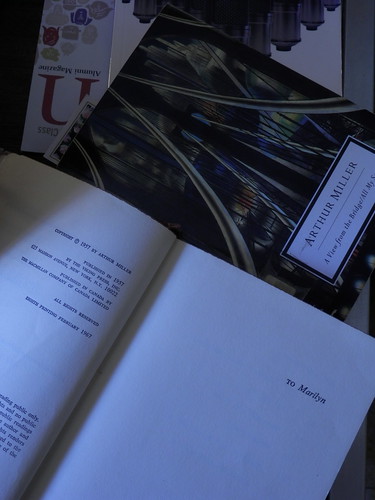
From Arthur Miller's Collected Plays (Viking Press, 1957, 3-55). Introduction by the author, following the dedication "To Marilyn".
INTRODUCTION
TO THE COLLECTED PLAYS
I
As a writer of plays I share with all specialists a suspicion of
generalities about the art and technique of my craft, and I lack both
the scholarly patience and the zeal to define terms in such a way as to
satisfy everyone. The only other course, therefore, is to stop along the
way to say what I mean by the terms I use, quite certain as I do
so that I will be taken to task by no small number of people, but
hopeful at the same time that something useful may be said about this
art, a form of writing which generates more opinions and fewer
instructive critical statements than any other. To be useful it seems
impossible not to risk the obvious by returning always to the
fundamental nature of theater, its historic human function, so to speak.
For it seems odd, when one thinks of it, that an art which has always
been so expensive to produce and so difficult to do well should have
survived in much the same general form that it possessed when it began.
This is especially striking now, when almost alone among the arts the
theater has managed to live despite the devouring mechanization of the
age, and, in some places and instances, even to thrive and grow. Under
these circumstances of a very long if frequently interrupted history,
one may make the assumption that the drama and its production must
represent a well-defined expression of profound social needs, needs
which transcend any particular form of society or any particular
historic moment. It is therefore possible to speak of fundamentals of
the form too when its only tools of importance never change, there being
no possibility of a drama without mimicry, conflict, tale, or speech.
My approach to playwriting and the drama itself is organic; and to make
this glaringly evident at once it is necessary to separate drama from
what we think of today as literature. A drama ought not to be looked at
first and foremost from literary perspectives merely because it uses
words, verbal rhythm, and poetic image. These can be its most memorable
parts, it is true, but they are not its inevitable accompaniments. Nor
is it only convention which from Aristotle onward decreed that the play
must be dramatic rather than narrative in concept and execution. A
Greek's seat was harder than an American's and even he had to call a
halt to a dramatic presentation after a couple of hours. The
physiological limits of attention in a seated position enforce upon this
art an interconnected group of laws, in turn expressed by aesthetic
criteria, which no other writing art requires. But it is not my
intention here to vivisect dramatic form or the techniques of
playwriting. I only want to take advantage of this rare opportunity—a
collected edition—to speak for myself as to my own aims: not to give my
estimates of what can portentously be called the dramatic problem in
this time, but simply to talk in workaday language about the problem of
how to write so that one's changing vision of people in the world is
more accurately represented in each succeeding work.
A few of the inevitable materials of the art dictate to me certain
aesthetic commitments which may as well be mentioned at the outset, for
they move silently but nevertheless with potent influence through the
plays in this book as well as in my thoughts about them. These plays
were written on the assumption that they would be acted before
audiences. The "actor" is a person, and he no sooner appears than
certain elementary questions are broached. [By "the actor" Miller seems to refer at this point to the character in the play, not to the actor as a person—JAGL]
Who is he? What is he doing here? How does he live or make his living?
Who is he related to? Is he rich or poor? What does he think of himself?
What do other people think of him, and why? What are his hopes and
fears; and what does he say they are? What does he claim to want and
what does he really want?
The actor [character - JAGL] brings questions onto the stage just
as any person does when we first meet him in our ordinary lives. Which
of them a play chooses to answer, and how they are answered, are the
ruling and highly consequential imperatives which create the style of
the play, and control what are later called the stylistic levels of its
writing. If, for instance, the actor is masked as he appears and his
body movements are constricted and highly ordered, we instantly expect
that the common surfaces of life will also be breached by the kinds of
questions he or the play will respond to. He will very probably speak
about the theme or essential preoccupation of the play directly and
without getting to it by circuitous routes of naturalistic detail. If he
appears in the costume of his trade, class, or profession, however, we
expect that he or the play will give us the answers to his common
identity, and if they do not they risk our dissatisfaction and
frustration. In a word, the actor's appearance on the stage in normal
human guise leads us to expect a realistic treatment. The play will
either be intent upon rounding out the characters b y virtue of its
complete answers to the common questions, or will substitute answers to a
more limited group of questions whicvh, instead of being "human," are
thematic and are designed to form a symbol of meaning rather than an
apparency of the "real." It is the nature of the questions asked and
answered, rather than the language used—whether verse, ordinary slang,
or colorless prose—that determines whether the style is realistic or
non-realistic. When I speak of style, therefore, this is one of the
relationships I intend to convey. In this sense the tragedies of
Shakespeare are species of realism, and those of Aeschylus and Sophocles
are not. We know a great deal more about Macbeth and Hamlet, apart from
their functions as characters in their particular given dramas, than we
can ever surmise about Oedipus the king, or the heroes and heroines of
Strindberg's plays. To put it another way, when the career of a person
rather than the detail of his motives stands at the forefront of the
play, we move closer to non-realistic styles, and vice versa. I regard
this as the one immovable and irremediable quality which goes to create
one style or another. And there is always an organic connection rather
than a temperamental choice involved in the style in which a play is
written and must be performed. The first two plays in this book were
written and performed with the intention of answering as many of the
common questions as was possible. The Crucible,A Memory of Two Mondays, and A View from the Bridge were not so designed and to this extent they are a departure from realism.
Another decisive influence upon style is the conception and manipulation
of time in a play. Broadly speaking, where it is conceived and used so
as to convey a natural passage of hours, days, or months, the style it
enforces is pressed toward realism. Where action is quite opeanly freed
so that things mature in a moment, for instance, which would take a year
in life, a true license for non-realistic styles is thereby won. As is
obvious, the destruction of temporal necessity occurs in every play if
only to a rudimentary degree; it is impossible that in life people
should behave and speak in reference to a single thematic point for so
continuous a time. Events, therefore, are always collapsed and drawn
together in any drama. But as the collapsing process becomes more
self-evident, and as the selection of events becomes less and less
dominated by the question of their natural maturation, the style of the
play moves further and further away from realism. All My Sons attempts to account for time in terms of months, days, and hours. Death of a Salesman explodes the watch and the calendar. The Crucible is bound by natural time—or strives to appear so.
The compacting of time destroys the realistic style not only because it
violates our sense of reality, but because collapsing time inevitably
emphasizes an element of existence which in life is not visible or
ordinarily felt with equivalent power, and this is its symbolic meaning.
When a criminal is arraigned, for instance, it is the prosecutor's job
to symbolize his behaviour to the jury so that the man's entire life can
be characterized in one way and not in another. The prosecutor does not
mention the accused as a dog lover, a good husband and father, a
sufferer from eczema, or a man with the habit of chewing tobacco on the
left and not the right side of his mouth. Nor does he strive to account
for the long intervals of time when the accused was behaving in a way
quite contrary to that symbolic characterization. The prosecutor is
collapsing time—and destroying realism, by fastening only on those
actions germane to the construction of his symbol. To one degree or
another every play must do this or we should have to sit in a theater
for years in order to appreciate a character and his story. But where
the play does pretend to give us details of hours, months, and years
which are not clearly and avowedly germane to the symbolic meaning, we
come closer and closer to what is called a realistic style. In passing, I
should say that the Greek "unity" of time imposed on the drama was not
arbitrary but a concomitant of the preponderant Greek interest in the
fate and career of the hero rather than his private characteristics, or,
to put it another way, his social and symbolic side rather than his
family role.
Another material, so to speak, of drama is not describable in a word,
and has a less direct influence on style. I mention it, however, because
it is probably the most powerful influence on my way of writing and
enforces on me a kind of taste and approach to the art which marks these
plays. It is necessary, if one is to reflect reality, not only to
depict why a man does what he does, or why he nearly didn't do it, but
why he cannot simply walk away and say to hell with it. To ask this last
qustion of a play is a cruel thing, for evasion is probably the most
developed technique most men have, and in truth there is an
extraordinarily small number of conflicts which we must, at any cost,
live out to their conclusions. To ask this question is immediately to
impose on oneself not, perhaps, a style of writing but at least a kind
of dramatic construction. For I understand the symbolic meaning of a
character and his career to consist of the kind of commitment he makes
to life or refuses to make, the kind of challenge he accepts and the
kind he can pass by. I take it that if one could know enough about a
human being one could discover some conflict, some value, some
challenge, however minor or major, which he cannot find in itself to
walk away from or turn his back on. The structure of these plays, in
this respect, is to the end that such a conflict be discovered and
clarified. Idea, in these plays, is the generalized meaning of that
discovery applied to men other than the hero. Time, characterizations,
and other elements are treated differently from play to play, but all to
the end that that moment of commitment be brought forth, that moment
when, in my eyes, a man differentiates himself from every other man,
that moment when out of a sky full of stars he fixes on one star. I take
it, as well, that the less capable a man is of walking away from the
central conflict of the play, the closer he approaches a tragic
existence. In turn, this implies that the closer a man approaches
tragedy the more intense is his concentration of emotion upon the fixed
point of his commitment, which is to say the closer he approaches what
in life we call fanaticism. From this flows the necessity for scenes of
high and open emotion, and plays constructed toward climax rather than
evocation of a mood alone or of bizarre spectacle. (The one exception
among these plays is A Memory of Two Mondays—as will be seen later).
From such considerations it ought to be clear that the common tokens of
realism and non-realism are in themselves not acceptable as criteria.
That a play is written prosaically does not make it a realistic play,
and that the speech is heightened and intensified by imagery does not
set it to one side of realism necessarily. The underlying poem of the
play I take to be the organic necessity of its parts. I find the
arbitrary not poetry but indulgence. (The novel is another matter
entirely). A very great play can be mimed and still issue forth its
essential actions and their rudiments of symbolic meaning; the word, in
drama, is the transformation into speech of what is happening,
and the fiat for intense language is intensity of happening. We have had
more than one extraordinary dramatist who was a cripple as a writer,
and this is lamentable but not ruinous. Which is to say that I prize the
poetic above else in the theater, and because I do I insiste that the
poem truly be there.
II
The assumption—or presumption—behind these plays is that life has
meaning. I would add now, as their momentary commentator, that what they
meant to me at the time of writing is not in each instance the same as
what they mean to me now in the light of further experience. Plato, by
banning artists from citizanship in his ideal republic, expressed at
least a partial truth; the intention behind a work and its effects upon
the public are not always the same. Worse yet, in his conscious
intention the artist often conceals from himself an aim which can be
quite opposed to his fondest beliefs and ideas. Those more tempted by an
evil, for instance, are more likely to feel deeply about it than those
who have only known the good. From this, two ironic propositions
logically flow. The first is that a play's 'idea' may be useful as a
unifying force empowering the artist to evoke a cogent emotional life on
the stage, but that in itself it has no aesthetic value, since, after
all, it is only a means to an end. The second is that since every play
means something—even the play which denies all meaning to existence—the
"idea" of a play is its measure of value and importance and beauty, and
that a play which appears merely to exist to one side of "ideas" is an
aesthetic nullity.
Idea is very important to me as a dramatist, but I think it is time
someone said that playwrights, including the greatest, have not been
noted for the new ideas they have broached in their plays. Buy new I
mean an original idea invented by the playwright, quite as such things
are created, if infrequently, by scientists, and occasionally by
philosophers. Surely there is no known philosophy which was first
announced through a play, nor any ethical idea. No social concept in
Shaw's plays could have been much of a surprise to the Webbs and
thousands of other Socialists of the time; nor can Ibsen, Chekhov,
Strindberg, or O'Neill be credited with inventing any new thoughts. As a
matter of fact, it is highly unlikely that a new idea could be
successfully launched through a play at all, and this for several good
reasons.
A genuine invention in the realm of ideas must first emerge as an
abstruse and even partial concept. Be it Christianity, Darwinism,
Marxism, or any other that can with reason be called original it has
always been the product of proofs which, before they go to form a
complete and new concept, require years and often generations of
testing, research, and polemic. At first blush a new idea appears to be
very close to insanity because to be new it must reverse important basic
beliefs and assumptions which, in turn, have been institutionalized and
are administered by one or another kind of priesthood with a vested
interest in the old idea. Nor would the old idea be an idea at all,
strictly speaking, if some goodly section of the population did not
believe in it. If only because no dramatic structure can bear the brunt
of the incredulity with which any really new idea is greeted, the play
from would collapse under the burdens of having to deliver up the
mountain of proof required for a new idea to be believed. And this would
be true even if the audience were all philosophers—perhaps even truer,
for the philosopher requires proofs even more exact than the layman
does.
The dramatic form is a dynamic thing. It is not possible to dally in it
for reflection. The polemical method, as well as the scientific
exposition, the parable, or the ethical teaching, all depend upon a
process which, in effect, says, "What you believe is wrong for these
reasons; what the truth is is as follows." Tremendous energy must go
into destroying the validity of the ancient proposition, and destroying
it from an absolutely opposite viewpoint. An idea, if it is really new,
is a genuine humiliation for the majority of the people; it is an
affront not only to their sensibilities but to their deepest
convictions. It offends against the things they worship, whether God or
science or money.
The conflict between a new idea and the very notion of drama is
remorseless and not resolvable because, among other things, plays are
always performed before people sitting en masse and not alone. To a very
large degree, much greater than is generally realized, we react with a
surrounding crowd rather than against it; our individual criteria of
truth are set to one side and we are no longer at the mercy of a
performance alone, but of the surrounding reaction to it. A man walking
down a deserted street sees another man beating a horse; he does not
like this, he is possibly revolted by it, even angered. Perhaps he walks
on, or perhaps he stops to remonstrate with the horsewhipper, who then
perhaps threatens him with the same whip. Depending on the
character of the man, he either fights or decides it is none of his
business, really, and goes on about his life. The same man on the same
street, but this time a busy street with many people, sees the same
scene of cruelty. He is now behaving in public; he cries out and hears
his cries echoed; he is encouraged; he moves in to stop the cruelty and
when he himself is threatened the conflict in him over whether to back
off or to fight is much higher and more intense, for now he is
surrounded by the administrators of shame or the bestowers of honor—his
fellow men. He is no longer looking at the same scene in the same way;
the very significance of the experience is changed and more likely than
not his own actions. So it is the theater. Inevitably, to one degree or
another, we see what we see on the stars not only with our own eyes but
with the eyes of others. Our standards of right and wrong, good taste
and bad, must in some way come into either conflict or agreement with
social standards, and a truth, however true, is no longer merely itself,
but itself plus the conventional reaction to it; and in the case of a
genuinely new idea the conventional reaction, by definition, will come
down on it like a ton of bricks, and it is finished, however
conventionally written.
If plays have not broached new ideas, they have enunciated
not-yet-popular ideas which are already in the air, ideas for which
there has already been a preparation by non-dramatic media. Which is to
say that once an idea is "in the air" it is no longe an idea but a
feeling, a sensation, an emotion, and with these the drama can deal. For
one thing, where no doubt exists in the hearts of the people, a play
canot create doubt; where no desire to believe exists, a play cannot
create a belief. And again, this springs from the nature of dramatic
form and its inevitable dynamism; it must communicate as it proceedsand
it literally has no existence if it must wait until the audience goes
home to think before it can be appreciated. It is the art of the present
tense par excellence.
Thus it is that the forms, the accents, the intentions of the plays in
this book are not the same from play to play. I could say that my
awareness of life was not the same and leave it at that, but the truth
is wider, for good or for ill. It is also that the society to which I
responded in the past decade was constantly changing, as it is changing
while I write this sentence. These plays, in one sense, are my response
to what was "in the air," they are one man's way of saying to his fellow
men, "This is what you see every day, or think or feel; now I will show
you what you really know but have not had the time, or the
disinterestedness, or the insight, or the information to understand
consciously." Each of these plays, in varying degrees, was begun in the
belief that it was unveiling a truth already known but unrecognized as
such. My concept of the audience is of a public each member of which is
carrying about with him what he thinks is an anxiety, or a hope, or a
preoccupation which is his alone and isolates him from mankind; and in
this respect at least the function of a play is to reveal him to himself
so that he may touch others by virtue of the revelation of his
mutuality with them. If only for this reason I regard the theater as a
serious business, one that makes or should make man more human, which is
to say, less alone.
III
When All My Sons opened on Broadway it was called an "Ibsenesque"
play. Some people liked it for this reason and others did not. Ibsen is
relevant to this play but what he means to me is not always what he
means to other, either his advocates or his detractors. More often than
not, these days, he is thought of as a stage carpenter with a flair for
ideas of importance. The whole aim of shaping a dramatic work on strict
lines which will elicit a distinct meaning reducible to a sentence is
now suspect. "Life" is now more complicated than such a mechanical
contrasting of forces can hope to reflect. Instead, the aim is a
"poetic" drama, preferably one whose ultimate thought or meaning is
elusive, a drama which appears not to have been composed or constructed,
but which somehow comes to life on a stage and the flickers away. To
come quickly to the point, our theater inclines toward the forms of
adolescence rather than analytical adulthood. It is not my place to deal
in praise or blame but it seems to me that a fair judge would be
compelled to conclude, as a minimum, that the run of serious works of
the past decade have been written under an intellectually—as well as
electrically—diffused light. It is believed that any attempt to "prove"
something in a play is somehow unfair and certainly inartistic, if not
gauche, more particularly if what is being proved happens to be in any
overt way of social moment. Indeed, one American critic believes that
the narrowness of the theater audience—as compared with that for movies
and television—is the result of the masses' having been driven away from
the theater by plays that preached.
This is not, of course, a new attitude in the world. Every major
playwright has had to make his way against it, for there is and always
will be a certain amount of resentfulness toward the presumption of any
playwright to teach. And there will never be a satisfactory way of
explaining that no playwright can be praised for his high seriousness
and at the same time be praised for not trying to teach; the very
conception of a dramatic theme inevitably means that certain aspects of
life are selected and others left out, and to imagine that a play can be
written disinterestedly is to believe that one can make love
disinterestedly.
The debatable question is never whether a play ought to teach but
whether it is art, and in this connection the basic criterion—purely
technical considerations to one side—is the passion with which the
teaching is made. I hasten to add the obvious—that a work cannot be
judged by the validity of its teaching. But it is entirely misleading to
state that there is some profound conflict between art and the
philosophically or socially meaningful theme. I say this not out of a
preference for plays that teach but in deference to the nature of the
creative act. A work of art is not handed down from Olympus from a
creature with a vision as wide as the world. If that could be done a
play would never end, just as history has no end. A play must end, and
end with a climax, and to forge a climax the forces in life, which are
of infinite complexity, must be made finite and capable of a more or
less succint culmination. Thus, all dramas are to that extent
arbitrary—in comparison with life itself—and embody a viewpoint if not
an obsession on the autho'rs part. So that when I am told that a play is
beautiful and (or because) it does not try to teach anything, I can
only wonder which of two things is true about it: either what it teaches
is so obvioius, so inconsiderable as to appear to the critic to be
"natural," or its teaching has been embedded and articulated so
thoroughly in the action itself as not to appear as an objective but
only a subjective fact. All My Sons was not my first play but the eighth
or ninth I had written up to the mid-forties. But for the one
immediately preceding it, none of the others were produced in the
professional theater, and since the reader can have little knowledge of
this one—which lasted less than a week on Broadway—and no knowledge at
all of the others, a word is in order about these desk-drawer plays,
particularly the failure called the Man Who Had All the Luck.
This play was an investigation to discover what exact part a man played
in his own fate. It deals with a young man in a small town who, by the
time he is in his mid-twenties, owns several growing businesses, has
married the girl he loves, is the father of a child he has always
wanted, and is daily becoming convinced that as his desires are
gratified he is causing to accumulate around his own head an invisible
but nearly palpable fund, so to speak, of retribution. The law of life,
as he observes life around him, is that people are always frustrated in
some important regard; and he conceives that he must be too, and the
play is built around his conviction of impending disaster. The disaster
never comes, even when, in effect, he tries to bring it on in order to
survive it and find peace. Instead, he comes to believe in his own
superiority, and in his remarkable ability to succeed.
Now, more than a decade later, it is possible for me to see that far
from being a waste and a failure this play was a preparation, and
possibly a necessary one, for those that followed, especially All My Sons and Death of a Salesman,
and this for many reasons. In the more than half-dozen plays before it I
had picked themes at random—which is to say that I had no awareness of
any inner continuity running from one of these plays to the next, and I
did not perceive myself in what I had written. I had begun with a play
about a family, then a play about two brothers caught on either side of
radicalism in a university, then a play about a psychologist's dilemma
in a prison where the sane were inexorably moving over to join the mad, a
play about a bizarre ship's officer whose desire for death led him to
piracy on the seas, a tragedy on the Cortes-Montezuma conflict, and
others. Once again, as I worked on The Man Who Had All the Luck I
was writing, I would have said, about what lay outside me. I had heard
the story of a young man in a midwestern town who had earned the respect
and love of his town and great personal prosperity as well, and who,
suddenly and for no known reason, took to suspecting everyone of wanting
to rob him, and within a year of his obsession's onset had taken his
own life.
In the past I had rarely spent more than three months on a play. Now the
months went by with the end never in sight. After nearly ten years of
writing I had struck upon what seemed a bottomless pit of mutually
cancelling meanings and implications. In the past I had had this
difficulty with forming a "story" and more with the exploration of its
meanings. Now, in contrast, I was working with an overwhelming sense of
meaning, but however I tried I could not make the drama continuous and
of a piece; it persisted, with the beginning of each scene, in starting
afresh as though each scene were the beginning of a new play. Then one
day, while I was lying on a beach, a simple shift of relationships came
to mind, a shift which did not and could not solve the problem of
writing The Man Who Had All the Luck, but, I think now, made at least two of the plays that followed possible, and a great deal else besides.
What I saw, without laboring the details, was that two of the
characters, who had been friends in the previous drafts, were logically
brothers and had the same father. Had I known then what I know now I
could have saved myself a lot of trouble. The play was impossible to fix
because the overt story was only tangential to the secret drama its
author was quite unconsciously trying to write. But in writing of the
father-son relationship and of the son's search for his relatedness
there was a fullness of feeling I had never known before; a crescendo
was struck with a force I could almost touch. The crux of All My sons, which would not be written until nearly three years later, was formed; and the roots of Death of a Salesman were sprouted.
The form of All My Sons is a reflection and an expression of
several forces, of only some of which I was conscious. I desired above
all to write rationally, to write so that I could tell the story of the
play to even an unlettered person and spark a look of recognition on his
face. The accusation I harbored against the earlier play was that it
could not make sense to common-sense people. I have always been in love
with wonder, the wonder of how things and people got to be what they
are, and in The Man Who Had All the Luck I had tried to grasp
wonder., I had tried to make it on the stage, by writing wonder. But
wonder had betrayed me and the only other course I had was the one I
took—to seek cause and effect, hard actions, facts, the geometry of
relationships, and to hold back any tendency to express an idea in
itself unless it was literally forced out of a character's mouth; in
other words, to let wonder rise up like a mist, a gas, a vapor from the
gradual and remorseless crush of factual and psychological conflict. I
went back to the great book of wonder, The Brothers Karamazov,
and I found what suddenly I felt must be true of it: that if one reads
its most colorful, breathtaking, wonderful pages, one finds the thickest
concentration of hard facts. Facts about the biographies of the
characters, about the kind of bark on the moonlit trees, the way a
window is hinged, the exact position of Dmitri as he peers through the
window at his father, the precise description of his father's dress.
Above all, the precise collision of inner themes during, not before or
after, the high dramatic scenes. And quite as sudeenly I noticed in
Beethoven the holding back of climax until it was ready, the graspe of
the rising line and the unwillingness to divert to an easy climax until
the true one was ready. If there is one word to name the mood I felt it
was Forego. Let nothing interfere with the shape, the direction,
the intention. I believed that I had gelt too mucho in the previous play
and understood too little.
I was turning thirty then, the author of perhaps a dozen plays, none of
which I could truly believe were finished. I had written many scenes,
but not a play. A play, I saw then, was an organism of which I had
fashioned only certain parts. The decision formed to write one more, and
if again it turned out to be unrealizable, I would go into another line
of work. I have never loved the brick and mortar of the theater, and
only once in my life had I been truly engrossed in a production—when
Ruth Gordon played in the Jed Harris production of "A Doll's House." The
sole sense of connection with theater came when I saw the productions
of the Group Theatre. It was not only the brilliance of ensemble acting,
which in my opinion has never been equaled since in America, but the
air of union created between actors and the audience. Here was the
promise of prophetic theater which suggested to my mind the Greek
situation when religion and belief were the heart of drama. I watched
the Group Theatre from fifty-five-cent seats in the balcony, and at
intermission time it was possible to feel the heat and the passion of
people moved not only in their bellies but in their thoughts. If I say
that my own writer's ego found fault with the plays it does not detract
from the fact that the performances were almost all inspiring to me, and
when I heard that the Group was falling apart it seemed incredible that
a society of saints—which they were to me, artistically, even as I had
never met one of them—should be made up of people with less than
absolute dedication to their cause. All My Sons was begun several years after the
Group had ceased to be, but it was what I can only call now a play
written for a prophetic theater. I am aware of the vagueness of the term
but I cannot do very well at definining what I mean. Perhaps it
signifies a theater, a play, which is meant to become part of the lives
of its audience—a play seriously meant for people of common sense, and
relevant to both their domestic lives and their daily work, but an
experience which widens their awareness of connection—the filaments to
the past and the future which lie concealed in "life."
My intention in this play was to be as untheatrical as possible. To that
end any metaphor, any image, any figure of speech, however creditable
to me, was removed if it even slightly brought to consciousness the hand
of a writer. So far as was possible nothing was to be permitted to
interfere with its artlessness.
It seems to me now that I had the attitude of one laying siege to a
fortress in this form. The sapping operation was to take place without a
sound beneath a clear landscape in the broad light of a peaceful day.
Nor was this approach arbitrary. It grew out of a determination to
reverse my past playwriting errors, and from the kind of story I
happened to have discovered.
During an idle chat in my living room, a pious lady from the Middle West
told of a family in her neighbourhood which had been destroyhed when
the daughter turned the father in to the authorities on discovering that
he had been selling faulty machinery to the Army. The war was then in
full blast. By the time she had finished the tale I had transformed the
daughter into a son and the climax of the second act was full nad clear
in my mind.
I knew my informant's neighbourhood, I knew its middle-class
ordinariness, and I knew how rarely the great issues penetrate such
environments. But the fact that a girl had not only wanted to, but had
actually moved against an erring father transformed into fact and common
reality what in my previous play I had only begun to hint at. I had no
awareness of the slightest connection between the two plays. All I knew
was that somehow a hard thing had entered into me, a crux toward which
it seemed possible to move in strong and straight lines. Something was
crystal clear to me for the first time since I had begun to write plays,
and it was the crisis of the second act, the revelation of the full
loathesomeness of an anti-social action.
With this sense of dealing with an existing objective fact, I began to
feel a difference in my role as a writer. It occurred to me that I must
write this play so that even the actual criminal, on reading it, would
have to say that it was true and sensible and as real as his life. It
began to seem to me that what I had written until then, as well as
almost of the plays I had seen, had been written for a theatrical
performance, when they should have been written as a kind of testimony
whose relevance far surpassed theatrics.
For these reasons the play begins in an atmosphere of undisturbed
normality. Its first act was later called slow, but it was designed to
be slow. It was made so that evern boredom might threaten, so that when
the first intimation of the crime is dropped a genuine horror might
begin to move into the heart of the audience, a horror born of of the
contrast between the placidity of the civilization on view and the
threat to it that a rage of conscience could create.
It took some two years to fashion this play, chiefly, I think now,
because of a difficulty not unconnected with a similar one in the
previous play. It was the question of relatedness. The crime in All My Sons is
not one that is about to be committed but one that has long since been
committed. There is no question of its consequences' being ameliorated
by anything Chris Keller or his father can do; the damage has been done
irreparably. The stakes remaining are purely the conscience of Joe
Keller and its awakening to the evil he has done, and the conscience of
his son in the face of what he has discovered about his father. One
could say that the problem was to make a fact of morality, but it is
more precise, I think, to say that the structure of the play is designed
to bring a man into the direct path of the consequences he has
wrought. In one sense, it was the same problem of writing about David
Beeves in the earlier play, for he too coule not relate himself to what
he had done. In both plays the dramatic obsession, so to speak, was with
the twofold nature of the individual—his own concept of his deeds, and
what turns out to be the "real" description of them. All My Sons
has often been called a moral play, and it is that, but the concept of
morality is not quite as purely ethical as it has been made to appear,
nor is it so in the plays that follow. That the deed of Joe Keller at
issue in All My Sons is his having been the cause of the death of
pilots in war obscures the other kind of morality in which the play is
primarily interested. Morality is probably a faulty word to use in the
connection, but what I was after was the wonder in the fact that the
consequences of actions are as real as the actions themselves, yet we
rarely take them into consideration as we perform actions, and we cannot
hope to do so fully when we must always act with only partial knowledge
of consequences. Joe Keller's trouble, in a word, is not that he cannot
tell right from wrong but that his cast of mind cannot admit that he,
personally, has any viable connection with his world, his universe, or
his society. He is not a partner in society, but an incorporated member,
so to speak, and you cannot sue personally the officers of a
corporation. I hasten to make clear here that I am not merely speaking
of a literal corporation but the concept of a man's becoming a function
of production or distribution to the point where his personality becomes
divorced from the actions it propels.
The fortress which All My Sons lays siege to is the fortress of
unrelatedness. It is an assertion not so much of morality in terms of
right and wrong, but of a moral world's being such because men cannot
walk away from certain of their deeds. In this sense Joe Keller is a
threat to society and in this sense the play is a social play. Its
"socialness" does not reside in its having dealt with the crime of
selling defective materials to a nation at war—the same crime could
easily be the basis of a thriller which would have no place in social
dramaturgy. It is that the crime is seen as having roots in a certain
relationship of the individual to society, and to a certain
indoctrination he embodies, which, if dominant, can mean a jungle
existence for all of us no matter how high our buildings soar. And it is
in this sense that loneliness is socially meaningful in these plays.
To return to Ibsen's influence upon this play. I should have to split
the question in order to make sense of it. First, there was the real
impact of his work upon me at the time: this consisted mainly in what I
then saw as his ability to forge a play upon a factual bedrock. A
situation in his plays is never stated but revealed in terms of hard
actions, irrevocable deeds; and sentiment is never confused with the
action it conceals. Having for so long written in terms of what people
felt rather than what they did, I turned to his works at the time with a
sense of homecoming. As I have said, I wanted then to write so that
people of common sense would mistake my play for life itself and not be
required to lend it some poetic license before it could be believed. I
wanted to make the moral world as real and evident as the immoral one so
splendidly is.
But my own belief is that the shadow of Ibsen was seen on this play for another reason, and it is that All My Sons
begins very late in its story. Thus, as in Ibsen's best-known work, a
great amount of time is taken up with bringing the past into the
present. In passing, I ought to add that this view of action is
presently antipathetic to our commonly held feeling about the drama.
More than any other quality of realism, or, to be more exact, of
Ibsenism as a technique, this creates a sense of artificiality which we
now tend to reject, for in other respects realism is still our reigning
style. But it is no longer acceptable that characters should sit about
discussing events of a year ago, or ten years ago, when in "life" they
would be busy with the present. In truth, the effort to eliminate
antecedent material has threatened to eliminate the past entirely from
many plays. We are impatient to get on with it—so much so that anyone
making a study of some highly creditable plays of the moment would be
hard put to imagine what their characters were like a month before their
actions and stories begin. All My Sons takes its time with the
past, not in deference to Ibsen's method as I saw it then, but because
its theme is the question of actions and consequences, and a way had to
be found to throw a long line into the past in order to make that kind
of connection viable.
That the idea of connection was central to me is indicated again in the
kind of revision the play underwent. In its earlier versions the mother,
Kate Keller, was in a dominating position; more precisely, her
astrological beliefs were given great prominence. (The play's original
title was The Sign of the Archer). And this, because I sought in
every sphere to give body and life to connection. But as the play
progressed the conflict between Joe and his son Chris pressed astrology
to the wall until its mysticism gave way to psychology. There was also
the impulse to regard the mystical with suspicion, since it had, in the
past, given me only turgid works that could never develop a true climax
based upon revealed psychological truths. In short, where in previous
plays I might well have been satisfied to create only an astrologically
obsessed woman, the obsession now had to be opened up to reveal its core
of self-interest and intention on the character's part. Wonder must
have feet with which to walk the earth.
But before I leave this play it seems wise to say a few more words about
the kind of dramatic impulse it represents, and one aspect of
"Ibsenism" as a technique is the quickest path into that discusssion. I
have no vested interest in any one form—as the variety of forms I have
used attests—but there is one element in Ibsen's method which I do not
think ought to be overlooked, let alone dismissed as it so often is
nowadays. If his plays, and his method, do nothing else they reveal the
evolutionary quality of life. One is constantly aware, in watching his
plays, of process, change, development. I think too many modern plays
assume, so to speak, that their duty is merely to show the present
countenance rather than to account for what happens. It is therefore
wrong to imagine that because his first and sometimes his second acts
devote so much time to a studied revelation of antecedent material, his
view is static compared to our own. In truth, it is profoundly dynamic,
for that enormous past was always heavily documented to the end that the
present be comprehended with wholeness, as a moment in a flow of time,
and not—as with so many modern plays—as a situation without roots.
Indeed, even though I can myself reject other aspects of his work, it
nevertheless presents barely and unadorned what I believe is the biggest
single dramatic problme, namely, how to dramatize what has gone before.
I say this not merely out of technical interest, but because dramatic
characters, and the drama itself, can never hope to attain a maximum
degree of consciousness unless they contain a viable unveiling of the
contrast between past and present, and an awareness of the process by
which the present has become what it is. And I say this, finally,
because I take it as a truth that the end of drama is the creation of a
higher consciousness and not merely a subjective attack upon the
audience's nerves and feelings.What is precious in the Ibsen method is
its insistence upon valid causation, and this cannot be dismissed as a
wooden notion.
This is the "real" in Ibsen's realism for me, for he was, after all, as
much a mystic as a realist. Which is simply to say that while there are
mysteries in life which no amount of analyzing will reduce to reason, it
is perfectly realistic to admit and even to proclaim that hiatus as a
truth. But the problem is not to make complex what is essentially
explainable; it is to make undestandable what is complex without
distorting and oversimplifying what cannot be explained. I think many of
his devices are, in fact, quite arbitrary; that he betrays a Germanic
ponderousness at times and a tendency to over-prove what is quite clear
in the first place. But we could do with more of his basic intention,
which was to assert nothing he had not proved, and to cling always to
the marvelous spectacle of life forcing one event out of the jaws of the
preceding one and to reveal its elemental consistencies with surprise.
In other words, I contrast his realism not with the lyrical, which I
prize, but with sentimentality, which is always a leak in the dramatic
dike. He sought to make a play as weithty and living a fact as the
discovery of the steam engine or algebra. This can be scoffed away only
at a price, and the price is a living drama.
IV
I think now that the straightforwardness of the All My Sons form
was in some part due to the relatively sharp definition of the social
aspects of the problem it dealt with. It was conceived in wartime and
begun in wartime; the spectacle of human sacrifice in contrast with
aggrandizement is a sharp and heartbreaking one. At a time when all
public voices were announcing the arrival of that great day when
industry and labor were one, my personal experience was daily
demonstrating that beneath the slogans very little had changed. In this
sense the play was a response to what I felt "in the air." It was an
unveiling of what I believed everybody knew and nobody publicly said. At
the same time, however, I believed I was bringing news, and it was news
which I half expected would be denied as truth.
When, in effect, it was accepted, I was gratified, but a little
surprised. The success of a play, especially one's first success, is
something like pushing against a door which is suddenly opened from the
other side. One may fall on one's face or not, but certainly a new room
is opened that was always securely shut until then. For myself, the
experience was invigorating. It suddenly seemed that the audience was a
mass of blood relations and I sensed a warmth in the world that had not
been there before. It made it possible to dream of daring more and
risking more. The Wonderful was no longer something that would
inevitably trap me into disastrously confusing works, for the audience
sat in silence before the unwinding of All My Sons and gasped
when they should have, and I tasted that power which is reserved, I
imagine, for playwrights, which is to know that by one's invention a
mass of strangers has been publicly tranfixed.
As well, the production of the play was an introduction to the acting
art and its awesome potentials. I wanted to use more of what lay in
actors to be used. To me, the most incredible spectacle of this first
successful production was the silence it enforced. It seemed then that
the stage was as wide and free and towering and laughingly inventive as
the human mind itself, and I wanted to press closer toward its distant
edges. A success places one among friends. The world is friendly, the
audience is friendly, and that is good. It also reveals, even more
starkly than a failure—for a failure is always ill-defined—what remains
undone.
The wonder in All My Sons lay in its revelation of process, and
it was made a stitch at a time, so to speak, in order to weave a
tapestry before our eyes. What it wanted, however, was a kind of
moment-to-moment wildness in addition to its organic wholeness. The form
of the play, I felt, was not sensuous enough in itself. Which means
that its conception of time came to appear at odds with my own
experience.
The first image that occurred to me which was to result in Death of a Salesman
was of an enormous face the height of the proscenium arch which would
appear and then open up, and we would see the inside of a man's head. In
fact, The Inside of His Head was the first title. It was
conceived half in laughter, for the inside of his head was a mass of
contradictions. The image was in direct opposition to the method of All My Sons—a method one might call linear or eventual in that one fact or incident creates the necessity for the next. The Salesman
image was from the beginning absorbed with the concept that nothing in
life comes "next" but that everything exists together and at the same
time within us; that there is no past to be "brought forward" in a human
being, but that he is his past at every moment and that the present is
merely that which his past is capable of noticing and smelling and
reacting to.
I wished to create a form which, in itself as a form, would literally be
the process of Willy Loman's way of mind. But to say "wished" is not
accurate. Any dramatic form is an artifice, a way of transforming a
subjective feeling into something that can be comprehended through
public symbols. Its efficiency as a form is to be judged—at least by the
writer—by how much of the original vision and feeling is lost or
distorted by this transformation. I wished to speak of the salesman most
precisely as I felt about him, to give no part of that feeling away for
the sake of any effect or any dramatic necessity. What was wanted now
was not a mounting line of tension, nor a gradually narrowing cone of
intensifying suspense, but a bloc, a single chord presented as such at
the outset, within which all the strains and melodies would already be
contained. The strategy, as with All My Sons, was to appear
entirely unstrategic but with a difference. This time, if I could, I
would have told the whole story and set forth all the characters in one
unbroken speech or even one sentence or a single flash of light. As I
look at the play now its form seems the form of a confession, for that
is how it is told, now speaking of what happened yesterday, then
suddenly following some connection to a time twenty years ago, then
leaping even further back and then returning to the present and even
speculating about the future.
Where in All My Sons it had seemed necessary to prove the
connections between the present and the past, between events and moral
consequences, between the manifest and the hidden, in this play all was
assumed as proven to begin with. All I was doing was bringing things to
mind. The assumption, also, was that everyone knew Willy Loman. I can
realize this only now, it is true, but it is equally apparent to me that
I took it somehow for granted then. There was still the attitude of the
unveiler, but no bringing together of hitherto unrelated things; only
pre-existing images, events, confrontations, moods, and pieces of
knowledge. So there was a kind of confidence underlying this play which
the form itself expresses, even a naïveté, a self-disarming quality that
was in part born of my belief in the audience as being essentially the
same as myself. If I had wanted, then, to put the audience reaction into
words, it would not have been "What happens next and why?" so much as
"Oh, God, of course!"
In one sense a play is a species of jurisprudence, and some part of it
must take the advocate's role, something else must act in defense, and
the entirety must engage the Law. Against my will, All My Sons states, and even proclaims, that it is a form and that a writer wrote it and organized it. In Death of a Salesman
the original impulse was to make that same proclamation in an
unmeasurably more violent, abrupt, and openly conscious way. Willy Loman
does not merely suggest or hint that he is at the end of his strength
and of his justifications, he is hardly on the stage for five minutes
when he says so; he does not gradually imply a deadly conflict with his
son, an implication dropped into the midst of serenity and surface calm,
he is avowedly grappling with that conflict at the outset. The ultimate
matter with which the play will close is announced at the outset and is
the matter of its every moment from the first. There is enough revealed
in the first scene of Death of a Salesman to fill another kind
of play which, in service to another dramatic form, would hold back and
only gradually release it. I wanted to proclaim that an artist had made
this play, but the nature of the proclamation was to be entirely
"inartistic" and avowedly unstrategic; it was to hold back nothing, at
any moment, which life would have revealed, even at the cost of suspense
and climax. It was to forego the usual preparations for scenes and to
permit—and even seek—whatever in each character contradicted his
position in the advocate-defense scheme of its jurisprudence. The play
was begun with only one firm piece of knowledge and this was that Loman
was to destroy himself. How it would wander before it got to that point I
did not know and resolved not to care. I was convinced only that if I
could make him remember enough he would kill himself, and the structure
of the play was determined by what was needed to draw up his memories
like a mass of tangled roots without end or beginning.
As I have said, the structure of events and the nature of its form are
also the direct reflection of Willy Loman's way of thinking at this
moment of his life. He was the kind of man you see muttering to himself
on a subway, decently dressed, on hi way home or to the office,
perfectly integrated with his surroundings excepting that unlike other
people he can no longer restrain the power of his experience from
disrupting the superficial sociality of his behavior. Consequently he is
working on two logics which often collide. For instance, if he meets
his son Happy while in the midst of some memory in which Happy
disappointed him, he is instantly furious at Happy, despite the fact
that Happy at this particular moment deeply desires to be of use to him.
He is literally at that terrible moment when the voice of the past is
no longer distant but quite as loud as the voice of the present. In
dramatic terms the form, therefore, is this process, instead of being a once-removed summation or indication of it.
The way of telling the tale, in this sense, is as mad as Willy and as
abrupt and as suddenly lyrical.And it is difficult not to add that the
subsequent imitations of the form had to collapse for this particular
reason. It is not possible, in my opinion, to graft it onto a character
whose psychology it does not reflect, and I have not used it since
becsause it would be false to a more integrated—or less
disintegrating—personality to pretend that the past and the present are
so openly and vocally intertwined in his mind. The ability of people to
down their past is normal, and without it we could have no
comprehensible communication among men. In the hands of writers who see
it as an easy way to elicit anterior information in a play it becomes
merely a flashback. There are no flashbacks in this play but only a
mobile concurrency of past and present, and this, again, because in his
desperation to justify his life Willy Loman has destroyed the boundaries
between now and then, just as anyone would do who, on picking up his
telephone, discovered that this perfectly harmless act had somehow set
off an explosion in his basement. The previously assumed and believed-in
results of ordinary and accepted actions, and their abrupt and
unforeseen—but apparently logical—effects, form the basic collision in
this play, and, I suppose, its ultimate irony.
It may be in place to remark, in this connection, that while the play
was sometimes called cinematographic in its structure, it failed as a
motion picture. I believe that the basic reason—aside from the gross
insensitivity permeating its film production—was that the dramatic
tension of Willy's memories was destroyed by transferring him,
literally, to the locales he had only imagined in the play. There is an
inevitable horror in the spectacle of a man losing consciousness of his
immediate surroundings to the point where he engages in conversation
with unseen persons. The horror is lost—and drama becomes narrative—when
the context actually becomes his imagined world. And the drama
evaporates because psychological truth has been amended, a truth which
depends not only on what images we recall but in what connections and
contexts we recall them. The setting on the stage was never shifted,
despite the many changes in locale, for the precise reason that, quite
simply, the mere fact that a man forgets where he is does not mean that
he has really moved. Indeed, his terror springs from his never-lost
awareness of time and place. It did not need this play to teach me that
the screen is time-bound and earth-bound compared to the stage, if only
because its preponderant emphasis is on the visual image, which, however
rapidly it may have changed before our eyes, still displaces its
predecessor, wwhile scene-changing with words is instantaneous; and
because of the flexibility of the language, especially of English, a
preceding image can be kept alive through the image that succeeds it.
The movie's tendency is always to wipe out what has gone before, and it
is thus in constant danger of transforming the dramatic into narrative.
There is no swifter method of telling a "story" but neither is there a
more difficult medium in which to keep a pattern of relationships
constantly in being. Even in those sequences which retained the real
backgrounds for Willy's imaginary confrontations the tension between now
and then was lost. I suspect this loss was due to the necessity of
shooting the actors close-up—effectively eliminating awareness of their
surroundings. The basic failure of the picture was a formal one. It did
not solve, nor really atempt to find, a resolution for the problem of
keeping the past constantly alive, and that friction, collision, and
tension between past and present was the heart of this play's particular
construction.
A great deal has been said and written about what Death of a Salesman
is supposed to signify, both psychologically and from the
socio-political viewpoints. For instance, in one periodical of the far
Right it was called a "time bomb expertly placed under the edifice of
Americanism," while the Daily Worker reviewer thought it entirely
decadent. In Catholic Spain it ran longer than any modern play and it
has been refused production in Russia but not, from time to time, in
certain satellite countries, depending on the direction and velocity of
the wind. The Spanish press, thoroughly controlled by Catholic
orthodoxy, regarded the play as commendable proof of the spirit's death
where there is no God. In America, even as it was being cannonaded as a
piece of Communist propaganda, two of the largest manufacturing
corporations in the country invited me to address their sales
organizations in conventions assembled, while the road company was here
and there picketed by the Catholic War Veterans and the American Legion.
It made only a fair impression in London, but in the area of the
Norwegian Arctic Circle fishermen whose only contact with civilization
was the radio and the occasional visit of the government boat insisted
on seeing it night after night—the same few people—believing it to be
some kind of religious rite. One organization of salesmen raised me up
nearly to patron-sainthood, and another, a national sales managers'
group, complained that the difficulty of recruiting salesmen was
directly traceable to the play. When the movie was made, the producing
company got so frightened it produced a sort of trailer to be shown
before the picture, a documentary short film which demonstrated how
exceptional Willy Loman was; how necessary selling is to the economy;
how secure the salesman's life really is; how idiotic, in short, was the
feature film they had just spent more than a million dollars to
produce. Fright does odd things to people.
On the psychological front the play spawned a small hill of doctoral
theses explaining its Freudian symbolism, and there were innumerable
letters asking if I was aware that the fountain pen which Biff steals is
a phallic symbol. Some, on the other hand, felt it was merely a
fountain pen and dismissed the whole play. I received visits from men
over sixty from as far away as California who had come across the
country to have me write the stories of their lives, because the story
of Willy Loman was exactly like theirs. The letters from women made it
clear that the central character of the play was Linda; sons saw the
entire action revolving around Biff or Happy, and fathers wanted advice,
in erffect, on how to avoid parricide. Probably the most succint
reaction to the play was voiced by a man who, on leaving the theater,
said, "I always said that New England territory was no damned good."
This, at least, was a fact.
That I have and had not the slightest interest in the selling profession
is probably unbelievable to most people, and I very early gave up even
trying to say so. And when asked what Willy Loman was selling, what was
in his bags, I could only reply, "Himself." I was trying neither to
condemn a profession nor particularly to improve it, and, I will admit, I
was little better than ignorant of freud's teachings when I wrote it.
There was no attempt to bring down the American edifice nor to raise it
higher, to show up family relations or to cure the ills afflicting that
inevitable institution. The truth, at least of my aim—which is all I can
speak of authoritatively—is much simpler and more complex.
The play grew from simple images. From a little frame house on a street
of little fame houses, which had once been loud with the noise of
growing boys, and then was empty and silent and finally occupied by
strangers. Strangers who could not know with what conquistadorial joy
Willy and his boys had once re-shingled the roof. Now it was quiet in
the house, and the wrong people in the beds.
It grew from images of futility—the cavernous Sunday afternoons
polishing the car. Where is that car now? And the chamois cloth
carefully washed and put to dry, where are the chamois cloths?
And the endless, convoluted discussions, wonderments, arguments,
belittlements, encouragements, fiery resolutions, abdications, returns,
partings, voyages out and voyages back, tremendous opportunities and
small, squeaking denouements—and all in the kitchen now occupied by
strangers who cannot hear what the walls are saying.
The image of aging and so many of your friends already gone and
strangers in the seats of the mighty who do not know you or your
triumphs or your incredible value.
The image of the son's hard, public eye upon you, no longer swept by
your myth, no longer rousable from his separateness, no longer knowing
you have lived for him and have wept for him.
The image of ferocity when love has turned to something elese and yet is
there, is somewhere in the room if one could only find it.
The image of people turning into strangers who only evaluate one another.
Above all, perhaps, the image of a need greater than hunger or sex or
thirst, a need to leave a thumbprint somewhere on the world. A need for
immortality, and by admitting it, the knowing that one has carefully
inscribed one's name on a cake of ice on a hot July day.
I sought the relatedness of all things by isolating their unrelatedness,
a man superbly alone with his sense of not having touched, and finally
knowing in his last extremity that the love which had always been in the
room unlocated was now found.
The image of a suicide so mixed in motive as to be unfathomable and yet
demanding statement. Revenge was in it and a power of love, a victory in
that it would bequeath a fortune to the living and a flight from
emptiness. With it an image of peace at the final curtain, the peace
that is between wars, the peace leaving the issues above ground and
viable yet.
And always, throughout, the image of private man in a world full of
strangers, a world that is not home nor even an open battleground but
only galaxies of high promise over a fear of falling.
And the image of a man making something with his hands being a rock to
touch and return to. "He was always so wonderful with his hands," says
his wife over his grave, and I laughed when the line came, laughed with
the artist-devil's laugh, for it had all come together in this line, she
having been made by him though he did not know it or believe in it or
receive it into himself. Only rank, height of power, the sense of having
won he believed was real—the galaxy thrust up into the sky by
projectors on the rooftops of the city he believed were real stars.
It came from structural images. The play's eye was to revolve from
within Willy's head, sweeping endlessly in all directions like a light
on the sea, and nothing that fromed in the distant mist was to be left
uninvestigated. It was thought of as having the density of the novel
form in its intechange of viewpoints, so that while all roads led to
Willy the other characters were to feel it was their play, a story about
them and not him.
There were two undulatin lines in mind, one above the other, the past
webbed to the present moving on together in him and sometimes openly
joined and once, finally, colliding in the showdown which defined him in
his eyes at leas—and so to sleep.
Above all, in the structural sense, I aimed to make a play with the
veritable countenance of life. To make one the many, as in life so that
"society" is a power and a mystery of custom and inside the man and
surrounding him, as the fish is in the sea and the sea inside the fish,
his birthplace and burial ground, promise and threat. To speak
commonsensically of social facts which every businessman knows and talks
about but which are too prosaic to mention are usually fancied up on
the stage as philosophical problems. When a man gets old you fire him,
you have to, he can't do the work. To speak and even to celebrate the
common sense of businessmen, who love the personality that wins the day
but know that you've got to have the right goods at the right price,
handsome and well-spoken as you are. (To some, these were scandalous and
infamous arraignments of society when uttered in the context of art.
But not to the businessmen themselves; they knew it was all true and I
cherished their clear-eyed talk.)
The image of a play without transitional scenes without transitional
scenes was there in the beginning. There was too much to say to waste
precious stage time with feints and preparations, in themselves
agonizing "structural" bridges for a writer to work out since they are
not why he is writing. There was a resolution, as in All My Sons,
not to waste motion or moments, but in this case to shear through
everything up to the meat of a scene; a resolution not to write an
unmeant word for the sake of the form but to make the form give and
stretch and contract for the sake of the thing to be said. To cling to
the process of Willy's mind as the form of the story would take.
The play was always heroic to me, and in later years the academy's
charge that Willy lacked the "stature" for the tragic hero seemed
incredible to me. I had not understood that these matters are measured
by Greco-Elizabethan paragraphs which hold no mention of insurance
payments, front porches, refrigerator fan belts, steering knuckles,
Chevrolets, and visions seen not through the portals of Delphi but in
the blue flame of the hot-water heater. How could "Tragedy" make people
weep, of all things?
I set out not to "write a tragedy" in this play, but to show the truth
as I saw it. However, some of the attacks upon it as a pseudo-tragedy
contain ideas so misleading, and in some cases so laughable, that it
might be in place here to deal with a few of them.
Aristotle having spoken of a fall from the heights, it goes without
saying that someone of the common mold cannot be a fit tragic hero. It
is now many centuries since Aristotle lived. There is no more reason for
falling down in a faint before his Poetics than before Euclid's
geometry, which has been amended numerous times by men with new
insights; nor, for that matter, would I choose to have my illnesses
diagnosed by Hippocrates rather than the most ordinary graduate of an
American medical school, despite the Greek's genius. Things do change,
and even a genius is limited by his time and the nature of his society.
I would deny, on grounds of simple logic, this one of Aristotle's
contentions if only because he lived in a slave society. When a vast
number of people are divested of alternatives, as slaves are, it is
rather inevitable that one will not be able to imagine drama, let alone
tragedy, as being possible for any but the higher ranks of society.
There is a legitimate question of stature here, but none of rank, which
is so often confused with it. So long as the hero may be said to have
had alternatives of a magnitude to have materially changed the course of
his life, it seems to me that in this respect at least, he cannot be
debarred from the heroic role.
The question of rank is significant to me only as it reflects the
question of the social application of the hero's career. There is no
doubt that if a character is shown on the stage who goes through the
most ordinary actions, and is suddenly revealed to be the President of
the United States, his actions immediately assume a much greater
magnitude, and pose the possibilities of much greater meaning, than if
he is the corner grocer. But at the same time, his stature as a hero is
not so utterly dependent upon his rank that the corner grocer cannot
outdistance him as a tragic figure—providing, of course, that the
grocer's career engages the issues of, for instance, the survival of the
race, the relationships of man to God—the questions, in short, whose
answers define humanity and the right way to live so that the world is a
home, instead of a battleground or a fog in which disembodied spirits
pass each other in an endless twilight.
In this respect Death of a Salesman is a slippery play to
categorize because nobody in it stops to make a speech objectively
stating the great issues which I believe it embodies. If it were a worse
play, less closely articulating its meanings with its actions, I think
it would have more quickly satisfied a certain kind of criticism. But it
was meant to be less a play than a fact; it refused submission to its
author's opinions and opened itself to a revelation of process and the
operations of an ethic, of social laws of action no less powerful in
their effects upon individuals than any tribal law administered by gods
with names. I need not claim that this play is a genuine solid gold
tragedy for my opinions on tragedy to be held valid. My purpose here is
simply to point out a historical fact which must be taken into account
in any consideration of tragedy, and it is the sharp alteration of the
meaning of rank in society between the present time and the distant
past. More important to me is the fact that this particular kind of
argument obscures much more relevant considerations.
One of these is the question of intensity. It matters not at all whether
a modern play concerns itself with a grocer or a president if the
intensity of the hero's commitment to his course is less than the
maximum possible. It matters not at all whether the hero falls from a
great height or a small one, whether he is highly conscious or only
dimly aware of what is happening, whether his pride brings the fall or
an unseen pattern written behind clouds; if the intensity, the human
passion to surpass his given bounds, the fanatic insistence upon his
self-conceived role—if these are not present there can only be an
outline of tragedy but no living thing. I believe, for myself, that the
lasting appeal of tragedy is due to our need to face the fact of death
in order to strengthen ourselves for life, and that over and above this
function of the tragic viewpoint there are and will be a great number of
formal variations which no single definition will ever embrace.
Another issue worth considering is the so-called tragic victory, a
question closely related to the consciousness of the hero. One makes
nonsense of this if a "victory" means that the hero makes us feel some
certain joy when, for instance, he sacrifices himself for a "cause," and
unhappy and morose because he dies without one. To begin at the bottom,
a man's death is and ought to be an essentially terrifying thing and
ought to make nobody happy. But in a great variety of ways even death,
the ultimate negative, can be, and appear to be, an assertion of
bravery, and can serve to separate the death of a man from the death of
animals; and I think it is this distinction which underlies any
conception of a victory in death. For a society of faith, the nature of
the death can prove the existence of the spirit, and posit its
immortality. For a secular society it is perhaps more difficult for such
a victory to document itself and to make itself felt, but, conversely,
the need to offer greater proofs of the humanity of man can make that
victory more real. It goes without saying that in a society where there
is basic disagreement as to the right way to live, there can hardly be
agreement as to the right way to die, and both life and death must be
heavily weighted with meaningless futility.
It was not out of any deference to a tragic definition that Willy Loman
is filled with a joy, however broken-hearted, as he approaches his end,
but simply that my sense of his character dictated his joy, and even
what I felt was an exultation. In terms of his character, he has
achieved a very powerful piece of knowledge, which is that he is loved
by his son and has been embraced by him and forgiven. In this he is
given his existence, so to speak—his fatherhood, for which he has always
striven and which until now he could not achieve. That he is unable to
take this victory thoroughly to his heart, that it closes the circle for
him and propels him to his death, is the wage of his sin, which was to
have committed himself so completely to the counterfeits of dignity and
the false coinage embodied in his idea of success that he can prove his
existence only by bestowing "power" on his posterity, a power deriving
from the sale of his last asset, himself, for the price of his insurance
policy.
I must confess here to a miscalculation, however. I did not realize
while writing the play that so many people in the world do not see as
clearly, or would not admit, as I thought they must, how futile most
lives are; so there could be no hope of consoling the audience for the
death of this man. I did not realize either how few would be impressed
by the fact that this man is actually a very brave spirit who cannot
settle for half but must pursue his dream of himself to the end.
Finally, I thought it must be clear, even obvious, that this was no dumb
brute heading mindlessly to his catastrophe.
I have no need to be Willy's advocate before the jury which decides who
is and is not a tragic hero. I am merely noting that the lingering
ponderousness of so many ancient definitions has blinded students and
critics to the facts before them, and not only in regard to this play.
Had Willy been unaware of his separation from values that endure he
hould have died contentedly while polishing his car, probably on a
Sunday afternoon with the ball game coming over the radio. But he was
agonized by his awareness of being in a false position, so constantly
haunted by the hollowness of all he had placed his faith in, so aware,
in short, that he must somehow be filled in his spirit or fly apart,
that he stalked his very life on the ultimate assertion. That he had not
the intellectual fluency to verbalize his situation is not the same
thing as saying that he lacked awareness, even an overly intensified
consciousness that the life he had made was without form and inner
meaning.
To be sure, he had been able to know that he was as much the victim of
his beliefs as their defeated exemplar, had he known how much of guilt
he ougth to bear and how much to shed from his soul, he would be more
conscious. But it seems to me that there is of necessity a severe
limitation of self-awareness in any character, even the most knowing,
which serves to define him as a character, and more, that this very
limit serves to complete the tragedy and, indeed, to make it at all
possible. Complete consciousness is possible only in a play about
forces, like Prometheus, but not in a play about people. I think
that the point is whether there is a sufficient awareness in the hero's
career to make the audience supply the rest. Had Oedipus, for instance,
been more conscious and more aware of the forces at work upon him he
must surely have said that he was not really to blame for having
cohabited with his mother since neither he nor anyone else knew she was
his mother. He must surely decide to divorce her, provide for their
children, firmly resolve to investigate the family background of his
next wife, and thus deprive us of a very fine play and the name for a
famous neurosis. But he is conscious only up to a point, the point at
which guilt begins. Now he is inconsolable and must tear out his eyes.
What is tragic about this? Why is it not even ridiculous? How can we
respect a man who goes to such extremities over something he could not
in any way help or prevent? The answer, I think, is not that we respect
the man, but that we respect the Law he has so completely broken
wittingly or not, for it is that Law which, we believe, defines us as
men. The confusion of some critics viewing Death of a Salesman in
this regard is that they do not see that Willy Loman has broken a law
without whose protection life is insupportable if not incomprehensible
to him and to many others; it is the law which says that a failure in
socieety and in business has no right to live. Unlike tha law against
incest, the law of success is not administered by statute or church, but
it is very nearly as powerful in its grip upon men. The confusion
increases because, while it is a law, it is by no means a wholly
agreeable one even as it is slavishly obeyed, for to fail is no longer
to belong to society, in his estimate. Therefore, the path is opened for
those who wish to call Willy merely a foolish man even as they
themselves are living in obedience to the same law that killed him.
Equally, the fact that Willy's law—the belief, in other words, which
administers guilt to him—is not a civilizing statute whose destruction
menaces us all; it is, rather, a deeply believed and deeply suspect
"good" which, when questioned as to its value, as it is in this play,
serves more to raise our anxieties than to reassure us of the existence
of an unseen but humane metaphysical system in the world. My attempt in
the play was to counter this anxiety with an oppsing system which, so to
speak, is in a race for Willy's faith, and it is the system of love
which is the opposite of the law of success. It is embodied in Biff
Loman, but by the time Willy can perceive his love it can serve only as
an ironic comment upon the life he sacrificed for power and for success
and its tokens.
V
A play cannot be equated with a political philosophy, at least not in
the way a smaller number, by simple multiplication, can be assimilated
into a larger. I do not believe that any work of art can help but be
diminished by its adherence at any cost to a political program,
including its author's, and not for any other reason than that there is
no political program—any more than there is a theory of tragedy—which
can encompass the complexities of real life. Doubtless an author's
politics must be one element, and even an important one, in the
germination of his art, but if it is art he has created it must by
definition bend itself to his observation rather than his opinions or
even his hopes. If I have shown a preference for plays which seek
causation not only in psychology but in society, I may also believe in
the autonomy of art, and I believe this because my experience with All My Sons and Death of a Salesman
forces the belief upon me. If the earlier play was Marxist, it was a
Marxism of a strange hue. Joe Keller is arraigned by his son for a
willfully unethical use of his economic position; and this, as the
Russians said when they removed the play from their stages, bespeaks an
assumption that the norm of capitalist behavior is ethical or at least
can be, an assumption no Marxist can hold. Nor does Chris propose to
liquidate the business built in part on soldiers' blood; he will run it
himself, but cleanly.
The most decent man in Death of a Salesman is a capitalist
(Charley) whose aims are not different from Willy Loman's. The great
difference between themis that Charley is not a fanatic. Equally,
however, he has learned how to live without that frenzy, that ecstasy of
spirit which Willy chases to his end. And even as Willy's sons are
unhappy men, Charley's boy, Bernard, works hard, attends to his studies,
and attains a worthwhile objective. These people are all of the same
class, the same background, the same neighborhood. What theory lies
behind this double view? None whatever. It is simply that I knew and
know that I feel better when my work is reflecting a balance of the
truth as it exists. A muffled debate arose with the success of Death of a Salesman
in which attempts were made to justify or dismiss the play as a
Left-Wing piece, or as a Right-Wing manifestation of decadence. The
presumption underlying both views is that a work of art is the sum of
its author's political outlook, real or alleged, and more, that its
political implications are valid elements in its aesthetic evaluation. I
do not believe this, either for my work or other writers' works.
The most radical play I ever saw was not Waiting for Lefty but The Madwoman of Chaillot.
I know nothing of Giraudoux's political alignment, and it is of no
moment to me; I am able to read this play, which is the most open
indictment of private exploitation of the earth I know about. By the
evidence of his plays, Shaw, the socialist, was in love not with the
working class, whose characters he could only caricature, but with the
middle of the economic aristocracy, those men who, in his estimate,
lived without social and economic illusions. There is a strain of mystic
fatalism in Ibsen so powerful as to throw all his scientific tenets
into doubt, and a good measure besides of contempt—in this radical—for
the men who are usually called the public. The list is long and the
contradictions are embarrassing until one concedes a perfectly simple
proposition. It is merely that a writer of any worth creates out of his
total perception, the vaster part of which is subjective and not within
his intellectual control. For myself, it has never been possible to
generate the energy to write and complete a play if I know in advance
everything it signifies and all it will contain. The very impulse to
write, I think, springs from an inner chaos crying for order, for
meaning, and that meaning must be discovered in the process of writing
or the work lies dead as it is finished. To speak, therefore, of a play
as though it were the objective work of a propagandist is an almost
biological kind of nonsense, provided, of course, that it is a play,
which is to say a work of art.
VI
In the writing of Death of a Salesman I tried, of course, to
achieve a maximum power of effect. But when I saw the devastating force
with which it struck its audiences, something within me was shocked and
put off. I had thought of myself as rather an optimistic man. I looked
at what I had wrought and was forced to wonder whether I knew myself at
all if this play, which I had written half in laughter and joy, was as
morose and as utterly sad as its audiences found it. Eithe I was much
tougher than they, and could stare at calamity with fewer terrors, or I
was harboring with myself another man who was only tangentially
connected with what I would have called my rather bright viewpoint on
mankind. As I watched and saw tears in the eyes of the audience I felt a
certain embarrassment at having, as I thought then, convinced so many
people that life was not worth living—for so the play was interpreted. I
hasten to add now that I ought not have been embarrassed, and that I am
convinced the play is not a document of pessimism, a philosophy in
which I do not believe.
Nevertheless, the emotionalism with which the play was received helped
to generate an opposite impulse and an altered dramatic aim. This
ultimately took shape in The Crucible, but before it became quite
so definite and formed into idea, it was taking hold of my thoughts in a
purely dramatic and theatrical context. Perhaps I can indicate its
basic elements by saying that Salesman moves with its arms open
wide, sweeping into itself by means of a subjective process of
thought-connection a multitude of observations, feelings, suggestions,
and shadings much as the mind does in its ordinary daily functionings.
Its author chose its path, of course, but, once chosen, that path could
meander as it pleased through a world that was well recognized by the
audience3. From the theatrical viewpoint that play desired the audience
to forget it was in a theater even as it broke the bounds, I believe, of
a long convention of realism. Its expressionistic elements were
consciously used as such, but since the approach to Willy Loman's
characterization was consistently and rigorously subjective, the
audience would not ever be aware—if I could help it—that they were
witnessing the use of a technique which had until then created only
coldness, objectivity, and a highly styled sort of play. I had willingly
employed expressionism but always to create a subjective truth, and
this play, which was so manifestly Written," seemed as though nobody had
written it at all but that it had simply "happened." I had always been
attracted and repelled by the brilliance of German expressionism after
World War I, and one aim in Salesman was to employ its quite
marvelous shorthand for humane, "felt" characterizations rather than for
purposes of demonstration for which the Germans had used it.
These and other technical and theatrical considerations were a preparation for what turned out to be The Crucible, but "what was in the air" provided the actual locus of the tale. If the reception of All My Sons and Death of a Salesman
had made the world a friendly place for me, events of the early fifties
quickly turned that warmth into an illusion. It was not only the rise
of "McCarthyism" that moved me, but something which seemed much more
weird and mysterious. It was the fact that a political, objective,
knowledgeable campaign from the far Right was capable of creating not
only a terror, but a new subjective reality, a veritable mystique which
was gradually assuming even a holy resonance. The wonder of it all
struck me that so practical and picayune a cause, carried forward by
such manifestly ridiculous men, should be capable of paralyzing thought
itself, and worse, causing to billow up such persuasive clouds of
"mysterious" feelings within people. It was as though the whole country
had been born anew, without a memory even of certain elemental decencies
which a year or two earlier no one would have imagined could be
altered, let alone forgotten. Astounded, I watched men pass me without a
nod whom I had known rather well for years; and again, the astonishment
was produced by my knowledge, which I could not give up, that the
terror in these people was being knowingly planned and consciously
engineered, and yet that all they knew was terror. That so interior and
subjective an emotion could have been so manifestly created from without
was a marvel to me. It underlies every word in The Crucible.
I wondered, at first, whether it must be that self-preservation and the
need to hold on to opportunity, the thought of being exiled and "put
out," was what the fear was feeding on, for there were people who had
had only the remotest connections with the Left who were quite as
terrified as those who had been closer. I knew of one man who had been
summoned to the office of a network executive and, on explaining that he
had had no Left connections at all, despite the then current attacks
upon him, was told that this was precisely the trouble; "You have
nothing to give them," he was told, meaning he had no confession to
make, and so he was fired from his job and for more than a year could
not recover the will to leave his house.
It seemed to me after a time that this, as well as other kinds of social
compliance, is the result of the sense of guilt which individuals
strive to conceal by complying. Generally it was a guilt, in this
historic instance, resulting from their awareness that they were not as
Rightist as people were supposed to be; that the tenor of public
pronouncements was alien to them and that they must be somehow
discoverable as enemies of the power overhead. There was a new
religiosity in the air, not merely the kind expressed by the spurt in
church construction and church attendance, but an official piety which
my reading of American history could not reconcile with the
free-wheeling iconoclasm of the country's past. I saw forming a kind of
interior mechanism of confession and forgiveness of sins which until now
had not been rightly categorized as sins. New sins were being created
monthly. It was very odd how quickly they were accepted into the new
orthodoxy, quite as though they had been there since the beginning of
time. Abover all, above all horrors, I saw accepted the notion that
conscience was no longer a private matter but one of state
administration. I saw men handing conscience to other men and thanking
other men for the opportunity of doing so.
I wished for a way to write a play that would be sharp, that would lift
out of the morass of subjectivism the squirming, single, defined process
which would show that the sin of public terror is that it divests man
of conscience, of himself. It was a theme not unrelated to those that
had invested the previous plays. In The Crucible, however, there
was an attempt to move beyond the discovery and unveiling of the hero's
guilt, a guilt that kills the personality. I had grown increasingly
conscious of this theme in my past work, and aware too that it was no
longer enough for me to build a play, as it were, upon the revelation of
guilt, and to rely solely upon a fate which exacts payment from the
culpable man. Now guilt appeared to me no longer the bedrock beneath
which the probe could not penetrate. I saw it now as a betrayer, as
possibly the most real of our illusions, but nevertheless a quality of
mind capable of being overthrown.
I had known of the Salem witch hunt for many years before "McCarthyism"
had arrived, and it had always remained an inexplicable darkness to me.
When I looked into it now, howver, it was with the contemporary
situation at my back, particularly the mystery of the handing over of
conscience which seemed to me the central and informing fact of the
time. One finds, I suppose, what one seeks. I doubt I should ever have
tempted agony by actually writing a play on the subject had I not come
upon a single fact. It was that Abigail Williams, the prime mover of the
Salem hysteria, so far as the hysterical children were concerned, had a
short time earlier been the house servant of the Proctors and now was
crying out Elizabeth Proctor as a witch; but more—it was clear from the
record that with entirely uncharacteristic fastidiousness she was
refusing to include John Proctor, Elizabeth's husband, in her
accusations despite the urgings of the prosecutors. Why? I searched the
records of the trials in the courthouse at Salem but in no other
instance could I find such a careful avoidance of the implicating
stutter, the murderous, ambivalent answer to the sharp questions of the
prosecutors. Only here, in Proctor's case, was there so clear an attempt
to differentiate between a wife's culpability and a husband's.
The testimony of Proctor himself is one of the least elaborate in the
records, and Elizabeth is not one of the major cases either. There could
have been numerous reasos for his having been ultimately apprehended
and hanged which are nowhere to be found. After the play opened, several
of his descendants wrote to me; and one believes that Proctor fell
unders suspicion because, according to family tradition, he had for
years been an amateur inventor whose machines appeared to some people as
devilish in their ingenuity, and—again according to tradition—he had
had to conceal them and work on them privately long before the witch
hunt had started, for fear of censure if not worse. The explanation does
not account for everything, but it does fall in with his evidently
liberated cast of mind as revealed in the record; he was one of the few
who not only refused to admit consorting with evil spirits, but who
persisted in calling the entire business a ruse and a fake. Most, if not
all, of the other victims were of their time in conceding the existence
of the immemorial plot by the Devil to take over the visible world,
their only reservation being that they happened not to have taken part
in it themselves.
It was the fact that Abigail, their former servant, was their accuser,
and her apparent desire to convict Elizabeth and save John, that made
the play conceivable for me.
As in any such mass phenomenon, the number of characters of vital, if
not decisive, importance is so great as to make the dramatic problem
excessively difficult. For a time it seemed best to approach the town
impressionistically, and, by a mosaic of seemingly disconnected scenes,
gradually to form a context of cause and effect. This I believe I might
well have done had it not been that the central impulse for writing at
all was not the social but the interior psychological question, which
was the question of that guilt residing in Salem which the hysteria
merely unleashed, but did not create. Consequently, the structure
reflects that understanding, and it centers in John, Elizabeth, and
Abigail.
In reading the record, which was taken down verbatim at the trial, I
found one recurring note which had a growing effect upon my concept, not
only of the phenomenon itself, but of our modern way of thinking about
people, and especially of the treatment of evil in contemporary drama.
Some critics have taken exception, for instance, to the unrelieved
badness of the prosecution in my play. I understand how this is
possible, and I plead no mitigation, but I was up against historical
facts which were immutable. I do not think that either the record itself
or the numerous commentaries upon it reveal any mitigation of the
unrelieved, straightforward, and absolute dedication to evil displayed
by the judges of these trials and the prosecutors. After days of study
it became quite incredible how perfect they were in this respect. I
recall, almost as in a dream, how Rebecca Nurse, a pious and universally
respected woman of great age, was literally taken by force from her
sickbed and ferociously cross-examined. No human weakness could be
displayed without the prosecution's stabbing into it with greater fury.
The most patent contradictions, almost laughable even in that day, were
overridden with warnings not to repeat their mention. There was a sadism
here that was breathtaking.
So much so, that I sought but could not at the time take hold of a
concept of man which might really begin to account for such evil. For
instance, it seems beyond doubt that members of the Putnam family
consciously, coldly, and with malice aforethought conferred in private
with some of the girls, and told them whom it was desirable to cry out
upon next. There is and will always be to my mind the spectacle of the
great minister, and ideological authority behind the prosecution, Cotton
Mather, galloping up to the scaffold to beat back a crowd of villagers
so moved by the towering dignity of the victims as to want to free them.
It was not difficult to foresee the objections to such absolute evil in
men; we are committed, after all, to the belief that it does not and
cannot exist. Had I this play to write now, however, I might proceed on
an altered concept. I should say that my own—and the critics'—unbelief
in this depth of evil is concomitant with our unbelief in good, too. I
should now examine this fact of evil as such. Instead, I sought to make
Dunforth, for instance, perceptible as a human being by showing him
somewhat put off by Mary Warren's turnabout at the height of the trials,
which caused so little confusion. In my play, Dunforth seems about to
conceive of the truth, and surely there is a disposition in him at least
to listen to arguments that go counter the line of the prosecution.
There is no such swerving in the record, and I think now, almost four
years after the writing of it, that I was wrong in mitigating the evil
of this man and the judges he represents. Instead, I would perfect his
evil to the utmost and make an open issue, a thematic consideration of
it in the play. I believe now, as I did not conceive then, that there
are people dedicated to evil in the world; that without their perverse
example we should not know the good. Evil is not a mistake but a fact in
itself. I have never proceeded psychoanalytically in my thought, but
neither have I been separated from that humane if not humanistic
conception of man as being essentially innocent while the evil in him
represents but a perversion of this frustrated love. I posit no
metaphysical force of evil which totally possesses certain individuals,
nor do I even deny that given infinite wisdom and patience and knowledge
any human being can be saved from himself. I believe merely that, from
whatever cause, a dedication to evil, not mistaking it for good, but
knowing it as evil and loving it as evil, is possible in human beings
who appear agreeable and normal. I think now that one of the hidden
weaknesses of our whole approach to dramatic psychology is our inability
to face this fact—to conceive, in effect, of Iago. The Crucible is a "tough" play. My criticism of it
now would be that it is not tough enough. I say this not merely out of
deference to the record of these trials, but out of a consideration for
drama. We are so intent upon getting sympathy for our characters that
the consequences of evil are being muddied by sentimentality under the
guise of a temperate weighing of causes. The tranquility of the bad man
lies at the heart not only of moral philosophy but dramaturgy as well.
But my central intention in this play was to one side of this idea,
which was realized only as the play was in production. All I sought here
was to take a step not only beyond the realization of guilt, but beyond
the helpless victimization of the hero.
The society of Salem was "morally" vocal. People then avowed principles,
sought to live by them and die by them. Issues of faith, conduct,
society, pervaded their private lives in a conscious wy. They needed but
to disapprove to act. I was drawn to this subject beccause the
historical moment seemed to give me the poetic right to create people of
higher self-awareness than the contemporary scene affords. I had
explored the subjective world in Salesman and I wanted now to move closer to a conscious hero.
The decidedly mixed reception to the play was not easily traceable. But I
believe there are causes for it which are of moment to more than this
play alone. I believe that the very moral awareness of the play and its
characters—which are historically correct—was repulsive to the audience.
For a variety of reasons I think that the Anglo-Saxon audience cannot
believe the reality of characters who live by principles and know very
much about their own characters and situations, and who say what they
know. Our drama, for this among other reasons, is condemned, so to
speak, to the emotions of subjectivism, which, as they approach
knowledge and self-awareness, become less and less actual and real to
us. In retrospect I think that my course in The Crucible should
have been toward greater self-awareness and not, as my critics have
implied, toward an enlarged and more persuasive subjectivism. The
realistic form and style of the play would hen have had to give way.
What new form might have evolved I cannot now say, but certainly the
passion of knowing is as powerful as the passion of feeling alone, and
the writing of the play broached the question of that new form for me.
The work of Berltolt Brecht inevitably rises up in any such quest. It
seems to me that, while I cannot agree with his concept of the human
situation, his solution of the problem of consciousness is admirably
honest and theatrically powerful. One cannot watch his productions
without knowing that he is at work not on the periphery of the
contemporary dramatic problem, but directly upon its center—which is
again the problem of consciousness.
VII
The Crucible, then, opened up a new prospect, and,
like every work when completed, it left behind it unfinished business.
It made a new freedom possible, and it also threw a certain light upon
the difference between the modern playwriting problem of meaning and
that of the age preceding the secularization of society. It is
impossible to study the trial record without feeling the immanence of a
veritable pantheon of life values in whose name both prosecution and
defense could speak. The testimony is thick with reference to Biblical
example, and even as religious belief did nothing to temper cruelty—and
in fact might be shown to have made the cruel crueler—it often served to
raise this swirling and ludicrous mysticism to a level of high moral
debate; and it did this despite the fact that most of the participants
were unlettered, simple folk. They lived and would die more in the
shadow of the other world than in the light of this one (and it is no
mean irony that the theocratic prosecution should seek out the most
religious people for its victims).
The longer I dwelt on the whole spectacle, the more clear became the
failure of the present age to find a universal moral sanction, and the
power of realisms's hold on our theater was an aspect of this vacuum.
For it began to appear that our inability to break more than the
surfaces of realism reflected our inability—playwrights and audiences—to
agree upon the pantheon of forces and values which must lie behind the
realistic surfaces of life. In this light, realism, as a style, could
seem to be a defense against the assertion of meaning. How strange a
conclusion this when one realizes that the same style seventy years ago
was the prime instrument of those who sought to illuminate meaning in
the theater, who divested their plays of fancy talk and improbable
locales and bizarre characters in order to bring "life" onto the stage.
And I wondered then what was true. Was it that we had come to fear the
hard glare of life on the stage and under the guise of an aesthetic
surfeited with realism were merely expressing our flight from reality?
Or was our condemned realism only the counterfeit of the original, whose
most powerful single impetus was to deal with man as a social animal?
Any form can be drained of its informing purpose, can be used to convey,
like the Tudor façades of college dormitories, the now vanished dignity
and necessity of a former age in order to lend specious justification
for a present hollowness. Was it realism that stood in the way of
meaning or was it the counterfeit of realism?
Increasingly over the past five years and more the poetic plays,
so-called, some of them much admired by all sorts of critics, were
surprisingly full of what in the university years ago was called "fine"
writing. If one heard less of the creak of plot machinery there was more
of the squeak of self-pity, the humming of the poetic poseur, the new
romance of the arbitrary and the uncompleted. For one, I had seen enough
of the "borrowings" of the set, the plot, the time-shifting methods,
and the lighting of Death of a Salesman to have an intimate
understanding of how a vessel could be emptied and still purveyed to the
public as new wine. Was realism called futile now because it needed to
illuminate an exact meaning behind it, a conviction that was no more
with us? Confusion, the inability to describe one's sense of a thing,
often issues in a genuine poetry of feeling, and feeling was now raised
up as the highest good and the ultimate attainment in drama. I had known
that kind of victory myself with Salesman; but was there not
another realm even highter, where feeling took awareness more openly by
the hand and both equally ruled and were illuminated? I had found a kind
of self-awareness in the bloody book of Salem and had thought that
since the natural, realistic surface of that society was one already
immersed in the questions of meaning and the relations of men to God, to
write a realistic play of that world was already to write in a style
beyond contemporary realism. That more than one one critic had found the
play "cold" when I had never written more passionately was by this time
an acceptable and inevitable detail of my fate, for, while it will
never confess to it, our theater is trained—actors, directors, audience,
and critics—to take to its heart anything that does not prick the mind
and to suspect everything that does not supinely reassure.
If Salesman was written in a mood of friendly partnership with the audience, The Crucible
reminded me that we had not yet come to terms. The latter play has been
produced more often than any of the others, and more successfully the
more time elapses from the headline "McCarthyism" which it was supposed
to be "about." I believe that on the night of its opening, a time when
the gale from the Right was blowing at its fullest fury, it inspired a
part of its audience with an unsettling fear and partisanship which
deflected the sight of the real and inner theme, which, again, was the
handing over of conscience to another, be it woman, the state, or a
terror, and the realization that with conscience goes the person, the
soul immortal, and the "name." That there was not one mention of this
process in any review, favorable or not, was the measure of my sense of
defeat, and the impulse to separate, openly and without concealment, the
action of the next play, A View from the Bridge, from its generalized significance. The engaged narrator, in short, appeared.
I had heard its story years before, quite as it appears in the play, and
quite as complete, and from time to time there were efforts to break up
its arc, to reshuffle the action so that I meight be able to find what
there was in it which drew me back to it again and again—until it became
like a fact in my mind, an unbreakable series of actions that went to
create a closed circle impervious to all interpretation. It was written
experimentally not only as a form, but as an exercise in interpretation.
I found in myself a passionate detachment toward its story as one does
toward a spectacle in which one is not engaged but which holds a
fascination deriving from its monolithic parfection If this had
happened, and if I could not forget it after so many years, there must
be some meaning in it for me, and I could write what had happened, why
it had happened, and to one side, as it were, express as much as I knew
of my sense of its meaning for me. Yet I wished to leave the action
intact so that the onlooker could seize the right to interpret it
entirely for himself and to accept or reject my reading of its
significance.
That reading was the awesomeness of a passion which, despite its
contradicting the self-interest of the individual it inhabits, despite
every kind of warning, despite even its destruction of the moral beliefs
of the individual, proceeds to magnify its power over him until it
destroys him.
I have not dealt with the business of production until now because it is
a subject large enough for separate treatment, but at this point it is
unavoidable. A View from the Bridge was relatively a failure in
New York when it was first produced; a revised version, published in
this volume, became a great success in London not long afterward. The
present version is a better play, I think, but not that much better; and
the sharp difference between the impressions each of the productions
created has a bearing on many themes that have been treated here.
Certain objective factors ought to be mentioned first. In New York, the play was preceded by A Memory of Two Mondays.
That one of its leading performers on opening night completely lost his
bearings and played in a state borderin on terror destroyd at the
outset any hope that something huma might be communicated by this
evening in the theater. A Memory of Two Mondays was dismissed so
thoroughtly that in one of the reviews, and one of the most important,
it was not even mentioned as having been played. By the time A View from the Bridge came
on, I suppose the critics were certain that they were witnessing an
aberration, for there had been no suggestion of any theatrical authority
in the first play's performance. It was too much to hope that the
second play could retrieve what had been so completely dissipated by the
first. A Memory of Two Mondays is a pathetic comedy; a
boy works among people for a couple of years, shares their troubles,
their victories, their hopes, and when it is time for him to be on his
way he expects some memorable moment, some sign from them that he has
been among them, that he has touched them and been touched by them. In
the sea of routine that swells around them they barely note his
departure. It is a kind of letter to that sub-culture where the sinews
of the economy are rooted, that darkest Africa of our society from whose
interior only the sketchiest messages ever reach our literature or our
stage. I wrote it, I suppose, in part out of a desire to relive a sort
of reality where necessity was open and bare; I hoped to define for
myself the value of hope, why it must arise, as well as the heroism of
those who know, at least, how to endure its absence. Nothing in this
book was written with greater love, and for myself I love nothing
printed here better than this play.
Nevertheless, the fact that it was seen as something utterly sad and
hopeless as a comment on life quite astonishes me still. After all, from
this endless, timeless, will-less environment, a boy emerges who will
not accept its defeat or its mood as final, and literally takes himself
off on a quest for a higher gratification. I suppose we simply do not
want to see how empty the lives of so many of us are even when the
depiction is made hopefully and not at all in despair. The play speaks
not of obsession but of rent and hunger and the need for a little poetry
in the life and is entirely out of date in those respects—so much so
that many took it for granted that it had been written a long time ago
and exhumed.
It shares with A View from the Bridge the impulse to present
rather than to represent an interpretation of reality. Incident and
character are set forth with the barest naïveté, and action is stopped
abruptly while commentary takes its place. The organic impulse behind Salesman, for instance, and All My Sons
is avowedly split apart; for a moment I was striving not to make people
forget they were in a theater, not to obliterate an awareness of form,
not to forge a pretense of life, but to be abrupt, clear, and explicit
in setting forth fact as fact and art as art so that the sea of
theatrical sentiment, which is so easily let in to drown all shape,
meaning, and perspective, might be held back and some hard outline of a
human dilemma be allowed to rise and stand. A Memory of Two Mondays
has a story but not a plot, because the life it reflects appears to me
to strip people of alternatives and will beyond a close and tight
periphery in which they may exercise a meager choice.
The contradiction in my attitude toward these two plays and what was
hoped for them is indicated by the experience of the two productions of A View from the Bridge,
the one a failure and "cold," the other quite the opposite. In writing
this play originally I obeyed the impulse to indicate, to telegraph, so
to speak, rather than to explore and exploit what at first had seemed to
me the inevitable and therefore unnecessary emotional implications of
the conflict. The Broadway production's setting followed the same
impulse, as it should have, and revealed nothing more than a platform to
contain the living room, the sea behind the house, and a Grecian-style
pediment overhanging the abstract doorway to the house. The austerity of
the production, in a word, expressed the reticence of the writing.
This version was in one act because it had seemed to me that the
essentials of the dilemma were all that was required, for I wished it
to be kept distant from the empathic flood whicvh a realistic portrayal
of the same tale and characters might unloose.
On seeing the production played several times I came to understand that,
like the plays written previously, this one was expressing a very
personal preoccupation and that it was not at all apart from my own
psychological life. I discovered my own relationships to what quite
suddenly appeared as, in some part, an analogy to situations in my life,
a distant analogy but a heartening proof that under the reticence of
its original method my own spirit was attempting to speak. So that when a
new production was planned for London it was not possible to let the
original go on as it was. Now there were additional things to be said
which it became necessary to say because I had come to the awareness
that this play had not, as I had almost believed before, been "given" to
me from without, but that my life had created it.
Therefore, many decisive alterations, small in themselves but
nonetheless great in their over-all consequences, began to flow into the
conception of the play. Perhaps the two most important were an altered
attitude toward Eddie Carbone, the hero, and toward the two women in his
life. I had originally conceived Eddie as a phenomenon, a rather
awesome fact of existence, and I had kept a certain distance from
involvement in his self-justifications. Consequently, he had appeared as
a kind of biological sport, and to a degree a repelling figure not
quite admissible into the human family. In revising the play it became
possible to accept for myself the implication I had sought to make clear
in the original version, which was that however one might dislike this
man, who does all sort of frightful things, he possesses or exemplifies
the wondrous and humane fact that he too can be driven to what in the
last analysis is a sacrifice of himself for his conception, however
misguided, of right, dignity, and justice. In revising it I found it
possible to move beyond contemplation of the man as a phenomenon into an
acceptance for dramatic purposes of his aims themselves. Once this
occurred the autonomous viewpoints of his wife and niece could be
expressed more fully and, instead of remaining muted counterpoints to
the march of Eddie's career, became involved forces pressing him forward
or holding him back and eventually forming, in part, the nature of his
disaster. The discovery of my own involvement in what I had written
modified its original friezelike character and the play moved closer
toward realism and called up the emphatic response of its audience.
The conception of the new production was in accordance with this new
perspective. Peter Brook, the London director, designed a set which was
more realistically detailed than the rather bare, if beautiful, New York
background, and at the same time emphasized the environment of the
neighbourhood. Its central idea was to bring the people of the
neighbourhood into the foreground of the action. Two high wings cloed to
form the face of the house where Eddie lived, a brick tenement, and
when opened revealed a basement living room. Overhead and at the sides
and across the back were stairways, fire escapes, passages, quite like a
whole neighbourhood constructed vertically. The easier economics of the
London theater made it possible to use many more neighbors than the
three or four extras we could hire in New York, and there was a
temperate but nevertheless full flow of strangers across the stage and
up and down its stairways and passages. The maturing of Eddie's need to
destroy Rodolpho was consequently seen in the context whcih could make
it of real moment, for the betrayal achieves its true proportions as it
flies in the face of the mores administered by Eddie's conscience—which
is also the conscience of his friends, co-workers, and neighbors and not
just his own autonomous creation. Thus his "oddness" came to disappear
as he was seen in context, as a creature of his environment as well as
an exception to it; and where originally there had been only a removed
sense of terror at the oncoming catastrophe, now there was pity and, I
think, the kind of wonder which it had been my aim to create in the
first place. It was finally possible to mourn this man.
Perhaps more than any other production experience, this helped to
resolve for me one important question of form and meaning. I warn,
however, that like everything else said here this is highly personal,
and even as I avow it I know that there are other paths and other
standards which can issue in a worthwhile kind of dramatic experience.
For myself, the theater is above all else an instrument of passion.
However important considerations of style and form have been to me, they
are only means, tools to pry up the well-worn, "inevitable" surfaces of
experience behind which swarm the living thoughts and feelings whose
expression is the essential purpose of art. I have stood squarely in
conventional realism; I have tried to expand it with an imposition of
various forms in order to speak more directly, even more abruptly and
nakedly of what has moved me behind the visible façades of life. Critics
have given me more praise than a writer can reasonably hope for and
more condemnation than one dares believe one has the power to survive.
There are certain distillations which remain after the dross rises to
the top and boils away, certain old and new commitments which, despite
the heat applied to them and the turmoil that has threatened to sweep
them away, nevertheless remain, some of them purified.
A play, I think, ought to make sense to common-sense people. I know what
it is to have been rejected by them, even unfairly so, but the only
challenge worth the effort is the widest one and the tallest one, which
is the people themselves. It is their innate conservatism which, I
think, is and ought to be the barrier to excess in experiment and the
exploitation of the bizarre, even as it is the proper aim of drama to
break down the limits of conventional unawareness and accpetance of
outmoded and banal forms.
By whatever means it is accomplished, the prime business of a play is to
arouse the passions of its audience so that by the route of passion may
be opened up new relationships between a man and men, and between men
and Man. Drama is akin to the other inventions of man in that it ought
to help us to know more, and not merely to spend our feelings.
The ultimate justification for a genuine new form is the new and
heightened consciousness it creates and makes possible—a consciousness
of causation in the light of known but hitherto inexplicable effects.
Not only in the drama, but in sociology, psychology, psychiatry, and
religion, the past half century has created an almost overwhelming
documentation of man as a nearly passive creation of environment and
family-created psychological drives. If only from the dramatic point of
view, this dictum cannot be accepted as final and "realistic" any more
than man's ultimate position can be accepted as his efficient use by
state or corporate apparatus. It is no more "real," however, for drama
to "liberate" itself from this vice by the route of romance and the
spectacle of free will and a new heroic formula that it is "real" now to
represent man's defeat as the ultimate implication of an overwhelming
determinism.
Realism, heightened or conventional, is neither more nor less an
artifice, a species of poetic symbolization, than any other form. It is
merely more familiar in this age. If it is used as a covering of safety
against the evaluation of life it must be overthrown, and for that
reason above the rest. But neither poetry nor liberation can come merely
from a rearrangement of the lights or from leaving the skeletons of
flats exposed instead of coverdd by painted cloths; not can it come
merely from the masking of the human face or the transformation of
speech into rhythmic verse, or from the expunging of common details of
life's apparencies. A new poem on the stage is a new concept of
relationships between the one and the many and the many and history, and
to create it requires great attention, not less, to the inexorable,
common, pervasive conditions of existence in this time and this hour.
Otherwise only a new self-indulgence is created, and it will be left
behind, however poetic its surface.
A drama worthy of its time must first, knowingly or by instinctive
means, recognize its major and most valuable traditions and where it has
departed from them. Determinism, whether it is based on the iron
necessities of economics or on psychoanalytic theory seen as a closed
circle, is a contradiction of the idea of drama itself as drama has come
down to us in its fullest developments. The idea of the hero, let alone
the mere protagonist, is incompatible with a drama whose bounds are set
in advance by the concept of an unbreakable trap. Nor is it merely that
one wants arbitrarily to find a hero and a victory. The history of man
is a ceaseless process of overthrowing one determinism to make way for
another more faithful to life's changing relationships. And it is a
process inconceivable without the existence of the will of man. His will
is as much a fact as his defeat. Any determinism, even the most
scientific, is only that stasis, that seemingly endless pause, before
the application of man's will administering a new insight into
causation.
The analogy to physics may not be out of place. The once-irreducible
elements of matter, whose behaqvior was seen as fixed and remorseless,
disintegrated under the controlled bombardment of atomic particles until
so fine a perception as the scale of atomic weights appears as a
relatively gross concept on the road to man's manipulation of the
material world. More to the point: even as the paths, the powers, and
the behavior of smaller and smaller elements and forces in nature are
brought into the fields of measurement, we are faced with the
dialectical irony that the act of measurement itself change tha particle
being measured, so that we can know only what it is at the moment when
it receives the impact of our rays, not what it was before it was
struck. The idea of realism has become wedded to the idea that man is at
best the sum of forces working upon him and of given psychological
forces within him. Yet an innate value, an innate will, does in fact
posit itself as real not alone because it is devoutly to be wished, but
because, however closely he is measured and systematically accounted
for, he is more than the sum of his stimuli and is unpredictable beyond a
certain point. A drama, like a history, which stops at this point, the
point of conditioning, is not reflecting reality. What is wanted,
therefore, is not a poetry of escape from process and determinism, like
that mood play which stops where feeling ends or that inverted
romanticism which would mirror all the world in the sado-masochistic
relationship. Nor will the heightening of the intensity of language
alone yield the prize. A new poem will appear because a new balance has
been struck which embraces both determinism and the paradox of will. If
there is one unseen goal toward which every play in this book strives,
it is that very discovery and its proof—that we are made and yet are
more than what made us.